Glastonbury we’re told is one of the most spiritual areas of the UK. This in part due to it being where Albion’s leylines converge. It’s also said to be where King Arthur is buried and even apparently played host to the Son of God when Joseph of Arimethea brought his Holy relative over for tea and cakes. Whether 5,000 were fed that day is, alas, unrecorded.
It’s perhaps not surprising that a place which is so steeped in history should be resisting the relentless march of modernity. This became apparent this week when the Glastonbury Why Wi-Fi Campaign hit the headlines in a (quiet) riot of lurid tie-dye and patchouli oil. The protestors' concerns focussed in part on the old chestnut of radiation emissions from the nearby Wi-Fi network. And while their concerns about the effects on people's health of the radiation may prove valid – although we should note that a ream of reports suggest otherwise - , they're also using all kinds of New Age unscientific to justify their oppostion. And natch this ia a lot harder to stomach.
Apparently, Wi-Fi signals are disturbing the “positive energy flows” of the area. You read that right. Matt Todd who makes it his business to campaign against electro motive forces is so convinced of this that he’s “started building small generators which he believes can neutralise the allegedly-harmful radiation using the principles of orgone science”. These devices “use quartz crystals, selenite (a clear form of the mineral gypsum), semi-precious lapis lazuli stones, gold leaf and copper coil to absorb and recycle the supposedly-negative energy,” the Telegraph reports.
The sad thing is that should the hippies win the day and cause the £35,000 scheme to be scrapped, there’ll be a host of losers. Young people will miss what had been a cheap way of getting online, while local businesses will also incur extra expense of having to pay for broadband. The real loser though will be science, as all the empiricism and learning of the modern world gets sacrificed on the altar of the Neo Pagans.
Wednesday, 7 January 2009

Tuesday, 6 January 2009
Broadband New Deal - Too Little, Too Late
This week Gordon Brown hinted that the government could be prepared to fund the development of a next-generation broadband network for the UK. It was a move welcomed by ISP’s shareholders, who are fearful of the impact that financing such a network would have on their dividend, and rank and file employees who are fearful for their jobs.
It was also embraced by economists on the grounds that the government is displaying foresight to recognise the importance of a next-gen network to the nation’s economic health and is ensuring the UK’s competitiveness in the global economy in years to come. Prudent Gordon we’re invited to believe is some sort of economic next-gen visionary who sees high-tech industries as the salvation of our economy. You’ll forgive me if I demur.
Surely if this were the case he’d have impressed upon telecomms the importance of a fibre-optic network more vehemently over the past five years. Instead they’ve been offered scant financial incentive to invest and have come under even less in the way of coercive strong arm tactics. The result is that the much-touted roll-out of a fibre optic network has been a total non-event. What’s especially galling is that had they been legally compelled to start committing money to the cause at a time when their incomes were booming it would have been less of a challenge to meet the £30 billion cost of construction.
Instead what’s happened is that we’ve had to wait until the country is on the verge of economic meltdown before any action has been taken. This leaves taxpayers bailing out companies who until recently had been enjoying huge profits from us as a result of the UK broadband boom.
These developments have however left one ISP looking like a shining model of virtue next to its peers. Virgin Media has funded its fibre optic network at huge expense and is now offering 50Mb to over 1.5 million homes with 12.6 million in line for the service by summer this year. In contrast, its larger rival BT, which has repeatedly dragged its heels over committing funding, emerges with its reputation, for me at least, eternally sullied.
Monday, 5 January 2009
Swoopo: The Con Is On
Recently it’s been de rigeur for newspapers to publish credit-crunch beating tips. You know the sort of thing: “Why not make your own chocolate cakes for Birthdays?”, the writer rhetorically asks. Adding that all we need do is “Simply buy some Green & Blacks bars and some Tesco Finest Almonds and follow this recipe“. I’ll tell you why not. Because your DIY, Blue Peter-style approach to saving money actually costs more than buying something sticky and lovely from high-end bakers Patisserie Valerie.
Anyway,in this spirit of debunking the Ivory Tower-ed mend and make do mentality, we move seamlessly onto a site called Swoopo.co.uk. This touts itself as an auction site which offers users the chance to buy sought-after electrical goods, such as Nintendo Wiis, PCs and laptops, for a fraction of the high street cost. Sounds too good to be true? My, my you’re a smart one. That’s because it is.
Swoopo.co.uk works by users buying the right to bid on an item, with each bid priced at 40 pence and increasing the cost of the lot by eight pence. Each bid then adds a further 20 seconds or so to the auction time. If you’re lucky enough to be the person placing the final bid you win the right to buy the lot at the final price. The cash accrued by the site from the process means that they receive many times what they paid for the item and enables them to sell the item at discounts of up to 70 per cent. Thus, we’re led to believe, the buyer gets a bargain.
Indeed, some testimonies from users bear out that cheap goods can be secured in this way. However, judging by the majority of reports on message boards what is happening more often is that bidders very rarely get win items and are spending vast sums of money on bids only to come away with nada.
That’s because they are in effect gambling, with the likelihood of winning being determined by lottery-style chance. You're unable to see how many other people are bidding, so are throwing money into the web ether blindly. If you’ve any sense you’ll give Swoopo the widest of wide berths.
Friday, 2 January 2009
Clockwork Remote Control Bringing Steampunk To Mainstream
A few months back the Guardian ran a piece on the burgeoning steampunk scene. It's a niche Science Fiction movement that fetishises the look of Victoriana and age-old technology such as steampower and imagines how more modern tech might have appeared had it been invented at this time in history. Take for example this natty looking PC which has been modded for Steampunk effect:

What a beauty, no? But strictly science fantasy, surely? Hmmm...yes and no. Earlier this week, for instance, everyone from Gizmodo to the Sun ran pieces on a remote control from ethicalsuperstore.com that does away with batteries in favour of a wind-up, clockwork mechanism. And while its none-more-grey styling is, in truth, pretty unlovely compared with some of the elegant wonders that Steampunk modders have come up with, the incorporation of archaic tech suggests that some of the movement's ideas have gone mainstream. You can see it below:

In the light of the acres of press coverage this has received it seems like huge sales for the remote are something of a given. Especially since it chimes perfectly with growing eco awareness. Similarly the device will also resonate with the new mood of econodriving that the credit crunch has induced. Going back to the future for now at least seems to be the way forward.

What a beauty, no? But strictly science fantasy, surely? Hmmm...yes and no. Earlier this week, for instance, everyone from Gizmodo to the Sun ran pieces on a remote control from ethicalsuperstore.com that does away with batteries in favour of a wind-up, clockwork mechanism. And while its none-more-grey styling is, in truth, pretty unlovely compared with some of the elegant wonders that Steampunk modders have come up with, the incorporation of archaic tech suggests that some of the movement's ideas have gone mainstream. You can see it below:
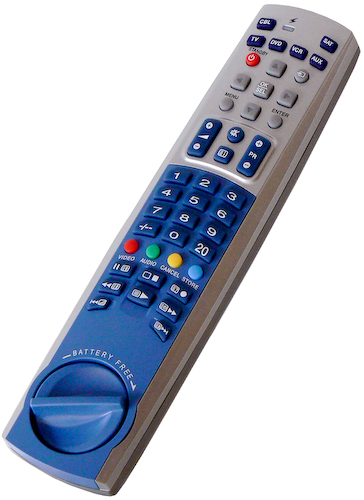
In the light of the acres of press coverage this has received it seems like huge sales for the remote are something of a given. Especially since it chimes perfectly with growing eco awareness. Similarly the device will also resonate with the new mood of econodriving that the credit crunch has induced. Going back to the future for now at least seems to be the way forward.
Tuesday, 30 December 2008
Star Wars USB Memory Sticks - Why Not Mobile Broadband Modems?

See above what are without doubt the finest looking USB memory sticks in Christendom. I got the Boba Fett one for Christmas and am happy to report that it's every bit as cool as the bounty hunter himself. Better yet, they're in limited runs of up to 5,000 and are individually numbered for collectability. And while fanboy purists might scoff at the Wicket the Ewok offering, I've always thought that the fluffy fellas' contribution to the Rebels' good fight was underrated. For me, they're akin to the Gurkhas of the Star Wars Universe - loyal almost to a fault and most pertinently full of spirit and scrapping despite their lack of size.
But I digress....A bit of digging reveals that Mimobot is the company behind these mini marvels and that as well as top grade Star Wars merch they're in the business of producing a whole host of branded and brilliant USB sticks. There's a series of Halo-themed products and a Domo range for fans of the cult Japanese anime. Or if it's designer toy stylings that float your boat, you can choose from hundreds of Pete Fowler-style goodies.
In fact, with the sheer range of desirable goods on offer, it makes the very functional-looking USB modem sticks now selling in vast quantities look like very plain girls at the digital party. And in this respect I can't help but feel that broadband providers might be missing a trick. After all, how much more likely would you be to choose one mobile broadband package over another if they offered you a range of eye-catching designs for their USB modems? I think we all know that the answer is VERY VERY LIKELY. More so, if the designs were limited edition and were made exclusive to a particular ISP.
If broadband companies have any smarts they'll apply their energies to ensure that fashionable, more individual looking USB modems become the NEXT BIG THING. You've only to look at what big business fashion mobile phone handsets have become to see the potential. A vast market of people who want devices that say more about them than the standard cold, grey bit of plastic that currently passes for a mobile USB modem could be lying there untapped.
Tuesday, 23 December 2008
HDTV with slow connections could spell doom for Virgin Media
Virgin Media’s big media blitz for 50Mb service and its USP of delivering high quality HDTV to its subscribers has been dealt a fresh blow today, with the launch of new software called HDi.
According to a report from the Telegraph, the technology is poised to allow consumers who “either cannot afford the highest speed broadband services, or those unable to subscribe to super-fast internet access because of the location of their home and their distance from a telephone exchange” to stream and download high-definition videos over the web.
Alki David, founder of video-streaming website FilmOn.com, who developed HDi, told the newspaper that it works by employing a compression technology that “squeezes the signal so it can be transmitted more quickly." The tech is currently in use by Mr David’s FilmOn service.
It strikes me that the big loser could be none other than Virgin Media. It’s hard to see how HDi will not hit demand for 50Mb service, one of the chief selling points of which was its capacity for delivering HDTV. Worryingly for the ISP, HDi is apparently being demonstrated to BT, the UK’s largest provider. Should therefore an exclusivity deal of some sort be signed between the two parties, Virgin Media's hopes that its faster service could prompt mass migration could be stymied in a stroke.
Doubling the agony for Virgin is that HDi’s launch follows sniping today that as more subscribers use its fibre optic network, the connection speeds it delivers will inevitably decline. This, in turn, followed a report from top internet iconoclasts the Reg that quoted CEO Neil Berkett as seeming to imply that the company was planning to target BitTorrent users. Given that gamers who legitimately use peer to peer sites and who might have expected to sign up for ping-free fast connections in spades will now be baulking at paying for as service that discriminates against them, this is an own goal of Lee Dixon proportions.
Virgin Media should be applauded for its willingness to invest in fibre optic technology capable of bringing of faster broadband to the UK. But it deserves little congratulations over how it has managed the launch of the 50Mb service. Where is now- departed media manipulator par excellance Richard Branson when they need him?
Monday, 22 December 2008
The Year's Most Irksome Ads
As the winter festivus becomes more and more tainted by commerce, it’s harder and harder to discern the real spirit of Christmas. But - credit crunch aside - if there’s one thing that’s guaranteed to stop people spending their hard-earned on fripperies and presents it’s shockingly bad and patronising advertising campaigns.
This year in particular they’ve been hard to avoid. Take, for example, those 'At Home with the Redknapps' Wii ads, which have seen the likes of top grade actorly types like Patrick Stewart and Julie Walters replaced by Heat magazine micro celebs. They’re nothing short of kryptonite for the credibility of the system.
Let's take a look at them, shall we? First up in the cast of characters, we’ve got a clapped-out ex-girl band member in the form of Louise. Then there’s Jamie Redknapp whose 'Come On Mawio' rotacising (sic) as he’s passed by Bullet Bill has got under my skin like very little else this year. And lest we forget…oh look there’s his Pops. Redknapp Snr’s “Come on you mugs! How’s that for a super smash attack?” exaltation is redolent of Patrick Moore’s legendary doddery appearances in the tips section of Games Master. With their blank expressions, it’s patently obvious that neither of these two coves have any idea what they’re saying.
Nintendo’s other big push has been for the new Animal Crossing installment. And they’ve erred here, too. As the ad's willowy blonde looks up whimsically at the stars and enjoys a soothing herbal tea, all I can think of is 'Jeebus, was there ever a drippier, more indie girl outside of a Talulah Gosh record?' What’s especially misjudged about it is that in my experience this kind of wet, ambient non-gaming isn’t what girls enjoy about the Wii. A truth borne out by the fact that the girls Mario Kart I play online with every Sunday drive like they’re in the Ben Hur chariot race and will stop at nothing short of murder to secure a win.
Alas, PC ads haven’t been much better. The 'I’m A PC' campaign from Apple continued to run this year and was no less irritating than it had been when they first aired in 2007. But perhaps the most galling are the PC World ads for Christmas which trumpet the virtues of the 3GB Acer laptop. We’re told in breathlessly enthusiastic detail that “Thanks to its massive memory and Intel core dual processor, it’s great for surfing the web, playing games and listening to your music. All at the same time!” Delivered with the zeal of someone bringing us news of bleeding-edge technology from the far flung future, the fatal flaw in his sales pitch is that multi-tasking on a computer would be amazing only if this was still 2002.
Subscribe to:
Posts (Atom)